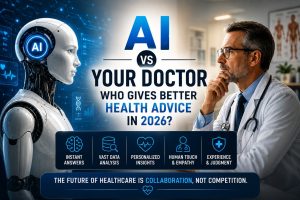
“Doctor, I already looked it up on ChatGPT — it says I have appendicitis.” I have heard some version of that sentence more times than I can count. And honestly? Sometimes the AI was right. A few years ago, asking a computer for health advice sounded absurd. Today, according to a 2026 survey by Pew Research Center, nearly 60% of adults regularly consult AI tools about health concerns before scheduling an appointment. As a physician with clinical experience across four continents and a deep interest in how artificial intelligence is reshaping our world, I want to give you the honest, evidence-grounded answer that most articles will not. The Healthcare Gap in 2026
Why Millions Are Turning to AI for Health AdviceLet us start with an uncomfortable truth: healthcare systems worldwide are under severe pressure. I have witnessed this firsthand from Lagos to London, from Buenos Aires to Brisbane. When your appointment is six weeks away, the specialist costs more than your rent, and it is 11 p.m. with a sick child — AI is not laziness. It is survival. AI offers three things healthcare chronically fails to provide: instant access (24/7, no waiting room), plain language explanations (no jargon, unlimited questions), and privacy (ask anything without stigma). For the full picture on how AI is reshaping income and daily life, see my deep-dive on AI and income at Happysimus.
Where AI Is Genuinely ImpressiveI use AI tools regularly in my own research, and some of what these systems can do is remarkable. Let me give credit where it is due. 1. Translating Complex Medical LanguageYou get a blood test back. The report reads “eGFR 58 mL/min/1.73m² with mild proteinuria.” Your next appointment is in three weeks. Modern AI can explain that in plain English within seconds — including what lifestyle changes might help and what questions to ask your doctor. A 2025 study in The BMJ found patients who used AI to understand test results arrived at appointments significantly better prepared. 2. Health Education at ScaleWant to understand what Type 2 diabetes really does to your body? How sleep affects your immune system? AI can synthesise thousands of journal articles into a personalised, readable summary in under ten seconds. For health literacy — the ability to understand and act on health information — AI may be the most powerful equaliser humanity has ever created. This is something I explore in depth in health and wellness at Happysimus. 3. Pattern Recognition in DiagnosticsAI trained on millions of medical images has demonstrated performance that matches or exceeds experienced physicians in specific tasks: Sources: The Lancet, Nature Medicine, NEJM 2024–2026 Where Your Doctor Still Wins — By a Wide Margin1. The Physical Examination: AI Cannot Touch YouI once diagnosed a life-threatening condition from the colour of a patient’s hands before reading a single test result. The subtle yellow tinge of early jaundice, the fine tremor of thyroid disease, the way someone protects their abdomen — these are findings no AI chatbot can assess through text. Medicine is a sensory profession. We listen, observe, touch, and interpret. 2. The Danger of Missing ContextA 55-year-old woman presents with fatigue. AI might suggest anaemia, thyroid issues, or sleep apnoea — all reasonable. But when I also know her mother died of ovarian cancer, she has been losing weight without trying, and has a new pelvic discomfort — the entire clinical picture changes. This is the essence of contextual reasoning, and it remains a distinctly human skill. 3. The Irreplaceable Human DimensionI have sat at more bedsides than I can count. Told people diagnoses they feared. Sat with grief and uncertainty and hope. There is something that happens in those moments — a human witnessing — that no algorithm can replicate.
As I also explore in the personal growth section of Happysimus, the therapeutic relationship itself has healing power — now being studied in the neuroscience of trust and placebo research.
⚠️ The Biggest Danger Nobody Is Talking AboutThe risk is not that AI is stupid. Modern AI health tools are often remarkably intelligent. The risk is that they sound confident even when they are wrong. This phenomenon — called “hallucination” — means AI can present inaccurate, outdated, or fabricated medical information in the same calm, authoritative tone it uses when perfectly correct. There is no blush, no hesitation, no “I am not entirely sure.”
A 2025 review in The Lancet Digital Health found that while AI performed well on standard questions, accuracy dropped significantly for uncommon presentations, drug-drug interactions, and patient-specific variables. The Real Winner: AI + Doctor TogetherThe framing of this debate has been wrong from the start. This is not a boxing match. The future of healthcare is not AI vs doctors — it is AI with doctors. The Ideal Healthcare Partnership
When a patient arrives having already used AI to understand their condition, having prepared specific questions, and having tracked their symptoms — the consultation becomes richer, faster, and more productive for everyone. For more on how AI is reshaping daily life and income, visit Happysimus AI & Income. So — Who Gives Better Health Advice?Here is my definitive, physician-tested answer after two decades of clinical practice:
Your 5-Step Practical Guide to Using Both Wisely1 Use AI to get informed, not diagnosed Ask AI: “What are the possible causes of X, and which require urgent attention?” Get orientation without replacing examination. 2 Prepare your appointments with AI Use AI to summarise your symptoms, timeline, and concerns in clear language before seeing your doctor. A prepared patient gets a better consultation. 3 Use AI to process what your doctor told you After your appointment, AI is excellent at helping you understand a diagnosis you have already received or a treatment that was prescribed. 4 Never use AI in an emergency Chest pain, breathing difficulty, stroke signs, severe bleeding — call emergency services immediately. Do not consult an AI chatbot. Time costs lives. 5 Cross-reference AI with trusted sources Verify with NHS UK, Mayo Clinic, WHO Health Topics, and Healthline. AI is a starting point, not the final word.
Final ThoughtsArtificial intelligence is not coming for your doctor’s job. It is coming for the administrative burden, the information gap, the 3 a.m. worry, and the language barrier between medical knowledge and the people who need it most. Used wisely, it is one of the most profound tools for democratising health knowledge humanity has ever produced. I say this as a physician who has worked in settings where a patient’s only access to health information was a two-hour bus ride to the nearest clinic. “The future of medicine belongs to those who learn to use both wisely — the intelligence of machines and the wisdom of healers.” — The Marcopera Stay curious, stay healthy, and remember: technology may become smarter every year, but you — the informed, engaged, empowered patient — remain the most important person in your own healthcare story.
Medical Disclaimer: This article is for educational and informational purposes only and does not constitute medical advice, diagnosis, or treatment. AI tools may generate inaccurate or outdated health information. Always consult a qualified healthcare professional. Never delay seeking professional care because of information from an AI system or website. | 📋 In This Article 🔑 Key Takeaway AI is not replacing your doctor. It is giving you tools to become a better, more informed, more empowered patient. Use both — wisely.
📰 Related Posts
How to Cash In on the AI Wave AI & Income · Happysimus
AI-Powered Health & Wellness Strategies Health & Wellness · Happysimus
The 10 Pillars of a Life Well Lived Personal Growth · Happysimus
📲 Follow Happysimus
▶ YouTube @happysimus 📷 Instagram @happysimus 🎵 TikTok @happpysimus f Facebook @happysimus
🏷️ Tags AI Health Doctor Advice ChatGPT Medicine Healthcare 2026 Health Tech Patient Power |


Helping You Thrive in the Age of AI
© 2026 Happysimus · Medical Disclaimer · Privacy Policy