
Health & Wellness · AI & Medicine · Global Health
By The Marcopera | Physician · OB-GYN Specialist · AI Educator · Founder, Happysimus
June 25, 2026 · Global Health & AI · 12 min read
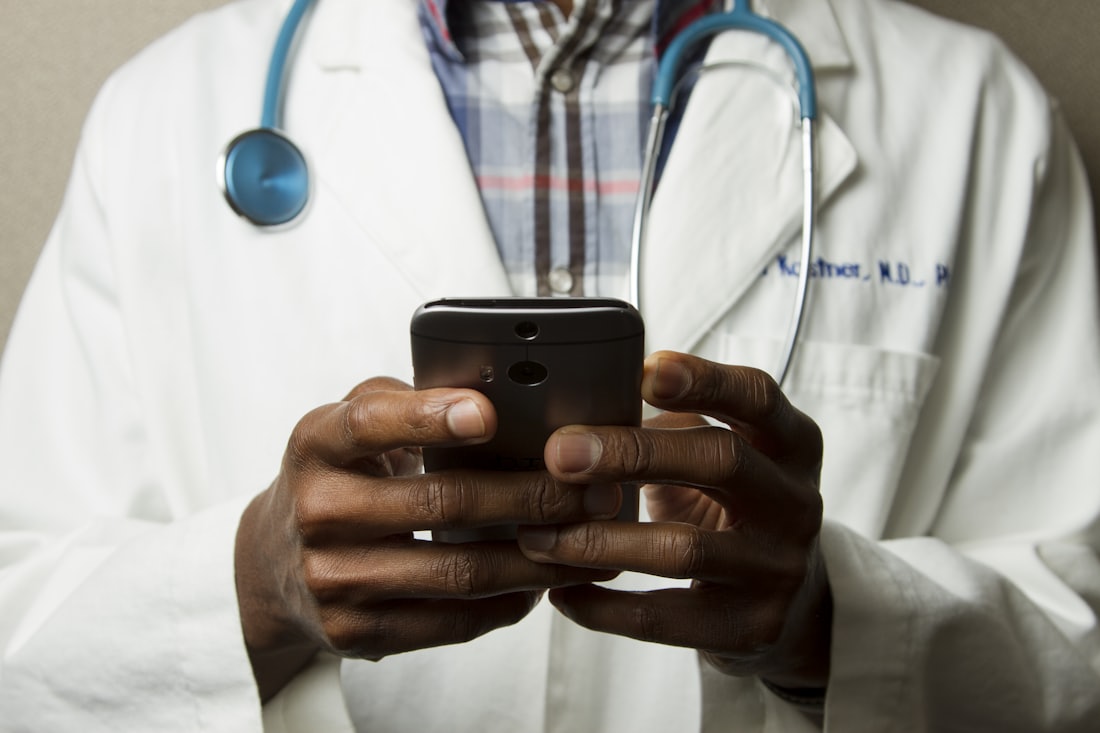
AI is not coming to Africa’s healthcare systems — in many places, it has already arrived. Photo: Unsplash
In 2024, a 28-year-old maize farmer in Siaya County, western Kenya, walked into a small public clinic complaining of a fever. Ten years earlier, he would have waited days — sometimes weeks — for a diagnosis. That afternoon, he walked out with the correct antimalarial drug in his hand. The entire process had taken ninety seconds. A community health worker had taken a photograph of a thick blood smear using an ordinary smartphone clipped to a USD 50 portable microscope. An artificial intelligence algorithm analysed the image and identified Plasmodium falciparum with 98.5% accuracy — better than most non-specialist laboratory technicians in the country. No radiologist. No pathologist. No laboratory. Just a phone, a clip-on lens, and an algorithm that understood what it was looking at. That story is not an experiment. It is not a pilot. It is happening — right now, across Africa and across the developing world — and it represents something I believe with genuine conviction as both a physician and as someone who has followed global health across multiple continents for many years: AI may be the single greatest equaliser in the history of medicine. This is the story of how. First, Understand the Scale of the ProblemTo appreciate why AI matters so profoundly for Africa and the developing world, you must first sit with the numbers. Not as statistics — but as human realities. 📊 THE HEALTHCARE GAP — BY THE NUMBERS
That last figure is the most telling. Africa carries a disproportionate share of the world’s disease burden — and yet produces less than 3% of the research that could address it. The world has, for decades, under-invested in the health of the majority of its population. And traditional solutions — building more hospitals, training more doctors, expanding infrastructure — move at a pace the need has long outrun. That is precisely why AI is not just useful in this context. It is transformative in a way that nothing else currently available can match. Because AI does not require a doctor to be physically present. It does not need a hospital. It can run on a smartphone. It can work offline. And it can scale instantaneously to a million patients at once.  A doctor who fits in a pocket — that is what AI promises for the developing world. Photo: Unsplash AI as Diagnostician — Seeing What No One Else CanThe most immediate and dramatic application of AI in African healthcare is diagnosis — and the results are not marginal improvements. They are complete paradigm shifts. Malaria kills over 600,000 people every year, the vast majority of them in Africa, the vast majority of those children under five. Traditional diagnosis requires a trained laboratory technician, a functional microscope, and time — none of which are reliably available in rural areas. Audere’s HealthPulse AI uses mobile-based computer vision to interpret malaria rapid diagnostic tests. In a peer-reviewed 2025 study in Kano State, Nigeria, it achieved 90.2% accuracy — significantly outperforming frontline health workers who achieved 76.1%. That gap is not a number. That gap is lives. Tuberculosis presents a similar story. In Nigeria, portable AI-powered X-ray systems are improving TB detection in areas that have no radiologists at all. Deep learning algorithms applied to chest X-rays have achieved diagnostic accuracies above 99% in controlled studies — comparable to specialist radiologists. In a continent where MDR-TB carries mortality rates between 20% and 40%, and where 60,000 cases are diagnosed annually, the clinical implications of earlier, more accurate diagnosis are enormous. HIV — which still carries a devastating burden across sub-Saharan Africa — is another frontier where machine learning is producing results. ML techniques identifying HIV predictors for screening, predicting treatment outcomes, and optimising antiretroviral regimens based on patient data are moving from research into clinical application. For a continent where healthcare worker shortages mean that a single clinician may be responsible for thousands of patients, AI decision support is not a luxury. It is a necessity. Saving Mothers — AI and the Maternal Health CrisisAs an OB-GYN specialist, this section is the one I find most personally significant — because maternal mortality remains one of the most devastating and preventable failures of global healthcare, and it falls most heavily on the developing world. Sub-Saharan Africa accounts for the majority of global maternal deaths. The causes are well-documented — haemorrhage, hypertension, sepsis, obstructed labour — and many are entirely preventable with early detection and timely intervention. The problem is not the knowledge. The problem is the absence of skilled healthcare workers at the moment of need, in the places where the need is greatest. AI is addressing this directly. In Kenya, trials with wearable monitoring bands tracked mothers through pregnancy — and the results were striking. Visits to clinics dropped by 30% while alerts came faster when intervention was needed. In South Africa, WhatsApp-based AI bots are handling 70% of routine health queries without requiring a nurse — freeing skilled staff to focus on higher-complexity care. A study reported 25% fewer birth complications among wearable users. In Ghana, the AI-powered telemedicine platform Nursebot uses natural language processing and machine learning to interact with patients, collect medical information, provide basic triage, and offer remote monitoring — bringing healthcare to rural communities that previously had almost none. A woman in a remote village with a high-risk pregnancy can now receive monitoring, guidance, and escalation through a platform she accesses on a basic smartphone. More than 2 million women live with untreated obstetric fistula in Asia and sub-Saharan Africa. Data mining techniques are now being applied to predict obstetric fistula risk in Tanzania — identifying women who need intervention before the damage occurs. That is not just medicine. That is justice.  Every maternal death is preventable with the right information at the right time. Photo: Unsplash Predicting Outbreaks Before They HappenOne of AI’s most powerful — and least discussed — applications in African public health is disease surveillance and outbreak prediction. This is not science fiction. It is happening, and it is already saving lives at scale. Machine learning models have been developed to predict malaria prevalence based on climatic factors — rainfall patterns, temperature, humidity — with significant accuracy across different African regions. In Burkina Faso, Random Forest algorithms using climate data explored malaria vector biting rates, producing accuracy results of 99%. Understanding where malaria will strike next — before it strikes — allows health authorities to pre-position bed nets, antimalarial drugs, and health workers. Prevention instead of reaction. Ebola surveillance is another frontier. AI models using Bayesian machine learning are being applied to enable faster outbreak detection, more accurate predictions of spread patterns, and more efficient allocation of emergency resources. For a continent that has lived through multiple devastating Ebola outbreaks — with response systems that have historically been reactive rather than anticipatory — this represents a fundamental shift in capability. AI analyses vast datasets from diverse sources simultaneously — electronic health records, social media patterns, environmental sensors, genomic data — and identifies anomalies that no human analyst could detect in time. That capability, in the context of Africa’s disease burden, is genuinely revolutionary. The Economic Dimension — AI as a Job Creator, Not Just a DoctorHere is a dimension of this story that rarely gets told — and it speaks directly to the AI & Income pillar of the Happysimus mission. The deployment of AI in African healthcare is not just saving lives. It is creating jobs, building technical capacity, and generating economic opportunity at the community level. Youth trained on AI tools for remote patient monitoring wearables. Women leading 30% of health-tech firms focused on maternal health applications. Developers in Lagos coding apps for local hospitals. Engineers in Nairobi building the next generation of diagnostic tools calibrated specifically for African disease profiles and African populations. The global AI healthcare market is projected to expand from $11.2 billion in 2023 to $427.5 billion by 2032. That growth will create enormous economic opportunity. The question is whether African nations — and the developing world broadly — will be participants and beneficiaries of that growth, or whether they will once again be consumers of technologies built elsewhere, for populations elsewhere, by people who have never visited a rural clinic in sub-Saharan Africa. The answer to that question is being written right now — in Lagos, Nairobi, Accra, Kigali, Cairo, and dozens of other cities where a new generation of African technologists, physicians, and entrepreneurs are building the health AI systems their continent actually needs. AI & INCOME The AI revolution is creating economic opportunity globally — including across Africa and the developing world. Learn the 3 real AI income tiers working in 2026. The Challenges Are Real — And Must Not Be MinimisedI would be doing a disservice to this topic — and to the populations it concerns — if I presented AI as a straightforward solution without honest acknowledgement of the barriers. The challenges are significant, structural, and in some cases deeply political. ⚠️ THE REAL BARRIERS TO AI HEALTHCARE IN AFRICA ① Algorithmic Bias Most AI health algorithms are trained predominantly on data from Western, high-income populations. When applied to African patients — with different disease presentations, different skin tones for imaging algorithms, different genetic profiles — the accuracy can degrade significantly. An algorithm that works brilliantly in Boston may underperform dangerously in Bamako. ② Infrastructure Gaps Reliable electricity, internet connectivity, and computing infrastructure remain inconsistent across much of the continent. Offline-capable AI tools and solar-powered servers address some of this — but the infrastructure gap remains a genuine constraint on scaling. ③ The “Pilot Trap” Africa is littered with successful AI health pilots that never scaled. The reasons are systemic: funding structures that support innovation but not implementation, regulatory frameworks that have not kept pace with technology, and health systems that lack the capacity to integrate new tools into existing workflows. Scaling AI in healthcare is less about proving algorithms work, and more about building health systems that can work with algorithms. ④ Digital Colonialism The most uncomfortable challenge. If AI health solutions for Africa are designed, owned, and controlled by external organisations — with African populations serving primarily as data sources — the result is a new form of technological dependency. For AI to truly transform African healthcare, it must be driven by African stakeholders, built on African data, and governed by African institutions.  The future of AI in African healthcare must be built by Africans, for Africans. Photo: Unsplash What Needs to Happen Next — A Physician’s PrescriptionThe five pillars that researchers identify as essential for transforming successful AI pilots into sustainable, nationally-integrated health programmes are worth stating clearly — because they represent the roadmap from promise to reality. ① Invest in local data collection Africa’s contribution to AI health research is 2.8% of global output. That number must grow — through funded programmes that collect diverse, representative, African health data to train algorithms that actually work for African patients. ② Build regulatory frameworks that enable rather than block Governance of AI health tools needs to move faster and smarter — frameworks that protect patients without strangling innovation, with clear accountability and ethical guidelines calibrated for local cultural, social, and economic contexts. ③ Train health workers, not just algorithms The human side of the AI equation is as important as the technical side. Health workers who understand, trust, and can effectively use AI tools are the bridge between a brilliant algorithm and a patient who benefits from it. ④ Channel funding toward scale, not just pilots The global AI healthcare market is growing toward $427.5 billion. A meaningful fraction of that capital needs to flow toward implementation infrastructure in developing nations — not just toward the next research paper or proof-of-concept demonstration. ⑤ Ensure African ownership and leadership The most sustainable AI health transformation in Africa will be one led by African technologists, governed by African institutions, and accountable to African communities. External partnerships are valuable — but they must operate as genuine collaborations, not as new forms of dependency. The Most Important Health Story of Our GenerationI want to close with a statement I believe deeply, as both a physician and as someone who has studied and worked across healthcare systems in different parts of the world. The history of global health has been, in many ways, a history of inequity. The best medicine has existed — but it has not existed everywhere. The knowledge has been available — but access to that knowledge has been rationed by geography, by income, by the accident of where you were born. A child in sub-Saharan Africa has had a profoundly different relationship with healthcare than a child in Western Europe — not because of biology, but because of systems. AI has the potential to disrupt that inequity at a speed and scale that no previous technology has managed. Not perfectly. Not without challenges. Not without the risk of replicating old power structures in new technological clothing. But with greater potential for genuine, transformative, population-level impact than anything I have seen in my medical career. “A farmer in western Kenya walked out of a clinic with the right medicine in ninety seconds. That is not a headline. That is a revolution. And it is only the beginning.” — The Marcopera The maize farmer in Siaya County got his diagnosis in ninety seconds. Two million women with obstetric fistula are waiting for the systems that can identify their risk before it becomes their reality. Six hundred thousand people are dying of malaria every year while 98.5%-accurate AI diagnostic tools sit in pilot programmes waiting for the funding and political will to scale. The technology exists. The evidence exists. The human need — urgent, vast, and entirely solvable — exists. What remains is the decision to match the ambition of the technology with the ambition of the investment. That is not a medical question. It is a moral one. About The Marcopera — Physician, OB-GYN specialist, ECFMG certified, certified life coach, healthcare cybersecurity analyst, AI educator, and founder of | 📚 Books by The Marcopera Weekly Planner for Men Blood Pressure Log Book Sudoku: 555+ Puzzles Diary & Daily Mood Tracker Dream Journal Gratitude Journal for Men Related Reading GLP-1 Weight Loss Drugs — What Nobody Is Telling You An OB-GYN’s unfiltered truth about Ozempic, Wegovy, fertility risks and the breast cancer finding. |


